
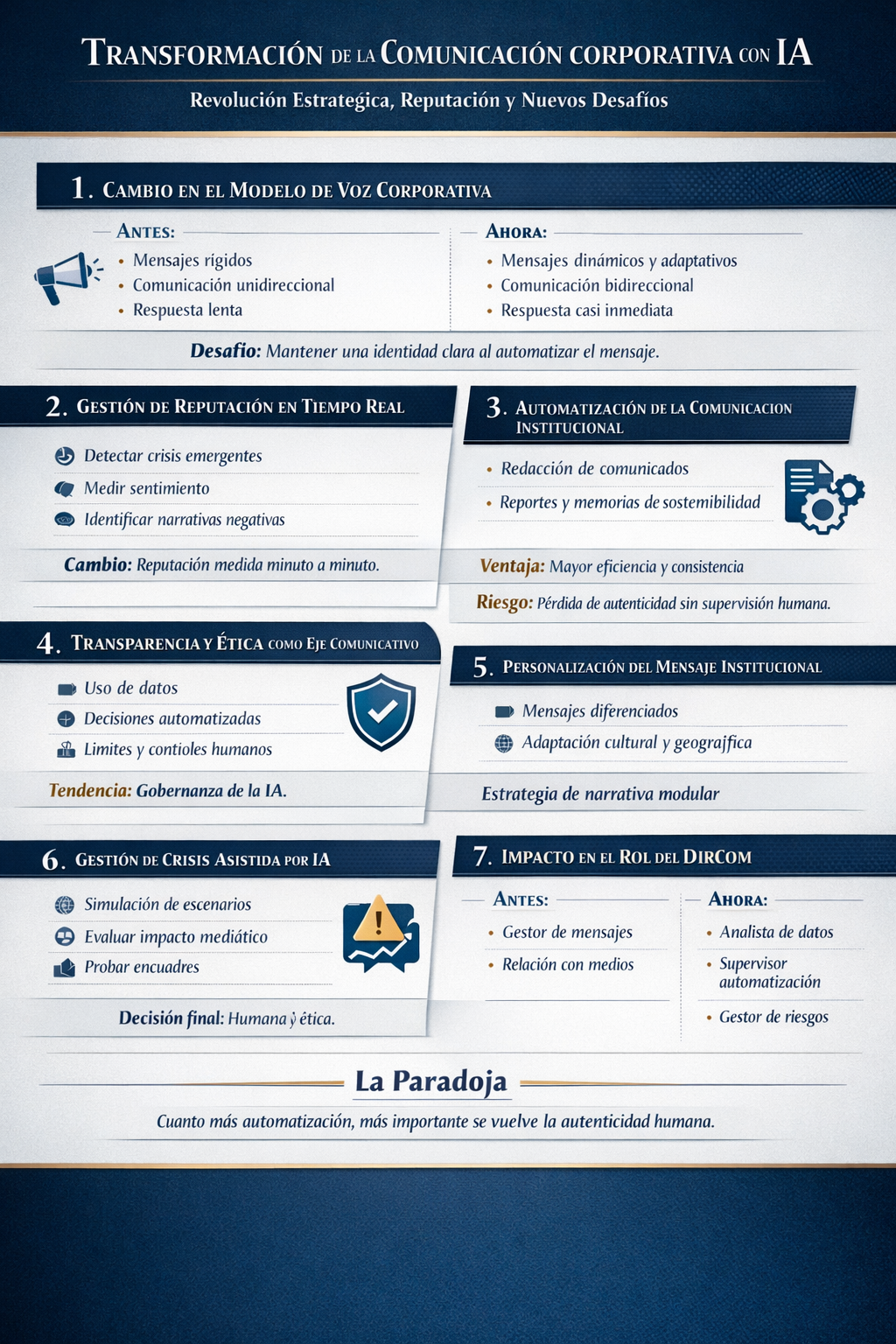
Artificial intelligence is profoundly transforming corporate communication, reshaping both the relationship between companies and their audiences and the strategic role of communication departments. The most significant shift is the transition from mass, reactive communication models to more personalized, predictive, and automated approaches.
One of the most visible changes concerns the corporate voice. In the past, organizations relied on rigid institutional messages and largely one-way communication, often with slow response times. Today, AI enables a more dynamic and adaptive communication style. Companies can tailor tone and content to different audiences — including customers, investors, and employees — and respond almost instantly. The key challenge is maintaining a coherent corporate identity when parts of the messaging process become automated.
Reputation management is also undergoing a structural transformation. Through advanced data analytics and social listening tools, companies can continuously monitor conversations across social media, digital platforms, and online forums. This allows organizations to detect emerging crises early, measure public sentiment, and respond with greater speed and strategic precision.
At the same time, AI is increasingly used to automate tasks such as drafting press releases, generating corporate reports, and preparing sustainability disclosures. While this improves efficiency and consistency, human oversight remains essential to preserve authenticity.
As a result, the role of the communications director is evolving toward a more analytical and strategic profile, focused on data interpretation, technological supervision, and transparency.
The more automation there is, the more important human authenticity becomes.
*No está permitido copiar ni difundir el contenido de esta web.